
Oven Repair in Metro Atlanta
An oven rarely dies all at once. It takes a little longer to preheat, cookies burn on one side, the display flashes a code you have never seen. Then one evening it does not heat at all. Moon Appliance Repair fixes gas and electric ovens in homes across Metro Atlanta — wall ovens, double ovens and the oven section of your range.
Call (470) 523-1606 or use the form. Tell us the brand, gas or electric, and what the oven is doing. We will give you a time window, often same- or next-day.
- Same- or next-day visits
- 6-month warranty
- EPA 608 certified
- Family-owned
Request a call-back
Prefer to talk? Calling is the fastest way to get on today's schedule.
(470) 523-1606- Same-day appointments in most of Metro Atlanta
- Genuine or OEM-approved parts
- 6-month warranty on parts and labor
- We'll only use your info for this repair — no spam, ever
What we fix
Refrigerators, freezers, ovens and ranges. Choose your appliance.
Oven Problems We Fix
- Oven will not heat. On an electric oven, the bake element, a thermal fuse, a relay on the control board or the wiring is the usual cause. On a gas oven, the igniter is the most common failure.
- Gas oven takes forever to light. Many gas ovens use a glowing hot-surface igniter. As it ages, it still glows but cannot draw enough current to open the gas valve. The oven clicks on late or not at all.
- Broil works, bake does not — or the other way around. Each has its own element or burner, and each can fail on its own.
- Uneven baking. A failed convection fan, a weak element, a sensor that reads wrong, or a door gasket that lets heat escape.
- Temperature is off. If a recipe that always worked now burns or comes out raw, the temperature sensor or the control may be off. We test the sensor and check the oven against a reference thermometer.
- Error code on the display. Codes usually point to the sensor, the door lock or the control board. Write the code down before you call.
- Self-clean will not start, or the door will not unlock. A door lock motor or switch has failed, or the oven is still too hot to release.
- Oven turns off by itself. A faulty sensor, an overheated control or a failing thermal fuse.
- Door will not close tight. Worn hinges or a damaged gasket let heat out and make the outside of the oven hot.
Gas Smell? Do This First
If you smell gas, do not turn on lights or appliances. Leave the house and call your gas utility or 911 from outside. An oven repair can wait until the gas company says the house is safe.
How Our Oven Repair Works
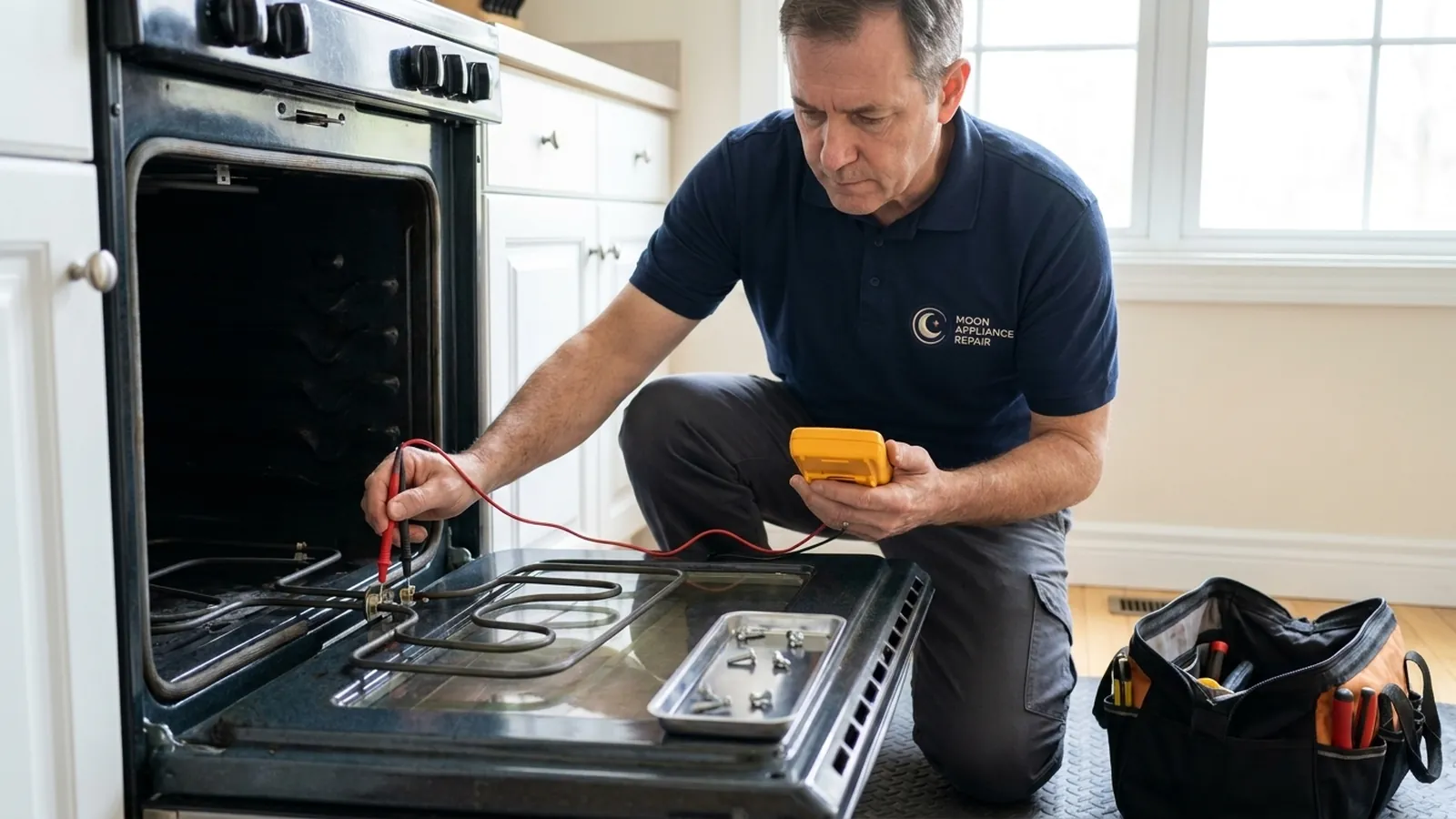
1. Diagnosis. The technician checks power or gas supply, tests the bake and broil elements or burners, measures the temperature sensor, checks the igniter, and reads any error codes from the control.
2. A clear explanation. You hear what failed and what the repair involves before any work begins, and you decide whether to go ahead.
3. Repair and test. We replace the failed part with a genuine or OEM-approved part, run the oven through a heat-up, and confirm it reaches and holds temperature. Our warranty covers parts and labor for up to 6 months.
Ovens We Repair
- Single and double wall ovens, gas and electric.
- The oven section of freestanding and slide-in ranges.
- Convection ovens — fans, fan motors and the third heating element behind the back panel.
- Ovens with steam or speed-cook features on many current models.
We service the brands you find in Metro Atlanta kitchens, including GE, Whirlpool, Frigidaire, Samsung, LG, KitchenAid, Maytag, Bosch, Electrolux, Kenmore, Amana and more. Our technicians have years of experience with these brands. Moon Appliance Repair is independent and not affiliated with any appliance manufacturer.
Gas Ovens and Electric Ovens Fail Differently
Electric ovens heat with a bake element at the bottom and a broil element at the top. Many convection models add a third element around the fan in the back. When an element burns out, you can sometimes see a blister or a break in it, but not always. Elements, the relays on the control board that switch them, the thermal fuse and the wiring are the parts we test.
Gas ovens use a bake burner under the oven floor and often a broil burner at the top. Most current gas ovens light the burner with a hot-surface igniter, which glows bright orange before the gas valve opens. The igniter weakens slowly, so the oven takes longer and longer to light before it stops lighting at all. The safety valve, the igniter and the control are the parts we check.
Both types use a temperature sensor inside the oven, a door switch, a cooling fan on many models and an electronic control. Those parts cause most "the oven acts strange" calls.
What Oven Error Codes Usually Mean
Every brand uses its own codes, and the owner's manual is the best place to look up yours. Most codes fall into a few groups:
- Sensor codes — the control reads a temperature that does not make sense. The sensor, its wiring or the control can be at fault.
- Door lock codes — the lock did not move when it should, often around self-clean.
- Overheat codes — the oven got hotter than it should. A stuck relay, a faulty sensor or a blocked cooling fan.
- Keypad or control codes — a stuck button, moisture behind the panel or a failing control board.
A code tells us where to start, not what to replace. We test the part and its wiring before ordering anything.
Oven Care That Helps It Last
- Wipe up spills after the oven cools. Burnt sugar and grease on the floor of the oven make smoke and can damage the finish.
- Use self-clean sparingly. The cycle runs very hot. If your oven has a lighter steam-clean option, use it for small jobs.
- Do not line the oven floor with foil unless your manual says it is allowed. It can trap heat, damage the enamel and block vents.
- Keep the door gasket clean and intact. A torn gasket lets heat out and makes the oven bake unevenly.
- Do not slam the door. Hinges and the glass take the hit.
Should You Repair or Replace Your Oven?
Elements, igniters, sensors, door locks, fans and control boards are all replaceable parts. A single failed part is almost always worth fixing, especially on a built-in wall oven, where a new one has to match the cutout in your cabinets.
Replacement makes more sense when several major parts fail at once, the oven cavity is rusted through, or parts for an older model are no longer made. If that is the situation, we tell you plainly.
Tips Before You Call
- Check the breaker. Electric ovens run on a double breaker. One half can trip and leave the display on while the oven stays cold.
- Check the clock and lockout. Some ovens will not heat if the clock is not set or a control lock is on. Your owner's manual explains how to clear it.
- Make sure the gas is on at the valve behind the range.
- Do not run self-clean to "fix" a problem. The high heat is hard on door locks, fuses and controls that are already weak.
Other Appliances We Repair
- Stove & Range Repair — burners that will not light, cooktops, knobs and controls.
- Refrigerator Repair — warm fridges, leaks and ice makers.
- Freezer Repair — frost, warm freezers and noise.
- Everything we fix is on the Moon Appliance Repair home page.
What Your Baking Results Are Telling You
The food often shows the problem before the oven does.
- Burned bottoms, pale tops. The bake element or bake burner is doing all the work, and the oven is not distributing heat. On convection models, check that the fan is turning. On gas ovens, a damaged heat shield under the oven floor can do the same.
- Pale bottoms, dark tops. Food placed too close to the broil element, or a broil element that switches on during bake when it should not — a control or relay issue.
- Everything takes longer than the recipe says. The oven may be running cooler than the display shows. A temperature sensor or a weak element is the usual cause.
- Preheat takes much longer than it used to. On gas ovens, a weakening igniter; on electric ovens, a bake element that has partly failed.
- One side browns faster than the other. Some unevenness is normal. A sudden change points to a fan, an element or a door gasket letting heat escape on one side.
- Smoke during normal baking. Usually spills on the oven floor, but a damaged element can smoke too. If you see sparks or a bright flash from an element, turn the oven off at the breaker and call.
Areas We Serve
We repair ovens across Metro Atlanta, including Alpharetta, Roswell, Suwanee, Cumming and Norcross. Enter your ZIP code in the form to check your address.
Our office address: 8601 Dunwoody Place, Sandy Springs, GA 30350.
Book Your Oven Repair
Call (470) 523-1606 — we answer 24/7 — or send the form, and we will call you back to schedule an oven repair.
Why Choose Moon Appliance Repair
Same- or next-day visits
For oven calls in most of Metro Atlanta.
15+ years
Fixing household appliances, ovens included.
EPA 608 certified technicians
So the same visit can cover a refrigerator or freezer too.
Background-checked and insured
Technicians in your kitchen.
Genuine or OEM-approved parts
On every oven job.
Up to 6 months of warranty
On parts and labor after an oven repair.
We are a family-owned company serving Metro Atlanta for oven repair.
Oven Repair FAQ
On most gas ovens the igniter has weakened. It glows but cannot open the gas valve. Replacing the igniter is a common, straightforward repair.
The bake element, a thermal fuse or a relay on the control board is the usual cause. The technician tests each one.
Many ovens let you adjust the temperature offset from the control panel. If the sensor itself is faulty, an adjustment will not fix it, so we test the sensor first.
Yes, gas and electric, single and double.
Let the oven cool completely. If the door still will not unlock, the lock motor or switch has likely failed, and we can replace it.
Genuine or OEM-approved parts on every oven repair we do.
Yes — up to 6 months on parts and labor.
No. Moon Appliance Repair is an independent, family-owned company. We name brands only to show which ovens we repair.
More repair pages
Cities
Fridge, freezer, oven or range down?
One call and we set up a visit, usually same- or next-day across Metro Atlanta.
Call (470) 523-1606